

Harvest time: May, 2026.
Origin: Okabe, Shizuoka, Japan
Cultivar: Meiryoku, Sayamakaori, Okumidori
Tea garden: Hattori Farm
Altitude: 200-300m
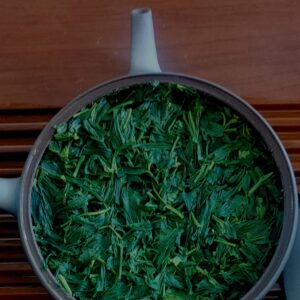
By steaming, the tea leaves acquire a rich dark green color and a deep flavor with a light grassy aroma.
Gyokuro grows in the shade. Blocking sunlight reduces catechin, which is the cause of bitterness, while theanine, the substance that gives sweetness to tea, increases, creating a vivid mild aroma.
Fukamushi teas are steamed longer than the usual brewing process during the production process, which further sweetens the taste and reduces bitterness and astringency.
Fukamushicha (deep-brewed tea) is a green tea that is initially steamed for longer than what is considered common. It is usually produced in Shizuoka Prefecture.
The usual process of steaming green tea takes about 30 to 40 seconds, and the resulting tea is called futsuumushicha (normal steamed tea). In contrast, fukamushicha is steamed for a minute or longer.
The steaming process makes a big difference in the taste of green tea. The main benefits of using the fukamushi process are to suppress the astringency, while more fullness and sweetness are obtained.
A longer steaming time makes the leaves very soft and brittle, and during the rolling process, the tops often break. Because of these finer particles, fukamushicha looks like the tea is of lower quality, which is the complete opposite of the real value of this tea.
Small particles of tea mean more health benefits. Just like with matcha and funmatsuch, when the small solid particles are drunk, you get more of the nutrients found in green tea (such as catechins), plus those that are not water-soluble like fiber, some vitamins, and chlorophyll.
Preparation
- 5 g tea
- 150-200 ml of water
- temperature 60-65°C
- 3 pour-overs: 1 min, 40 sec, 2 min